France's Online Casino Regulations and Video Poker Payout Dynamics
Mia Krause · Aug 21, 2026

France's Online Casino Regulations and Video Poker Payout Dynamics
France maintains a structured system for online casino oversight that directly shapes how video poker operators calculate and present payout percentages across digital platforms, with the Autorité Nationale des Jeux enforcing rules that require transparent reporting of return-to-player metrics for all licensed games including video poker variants.
Development of France's Digital Gambling Framework
Legislation passed in 2010 opened the market to regulated online operators while establishing strict licensing criteria, and subsequent updates have refined requirements around game fairness testing and payout disclosures that apply specifically to video poker titles offered through authorized sites. Observers note that these measures emerged from efforts to balance consumer protection with market growth, whereas earlier restrictions had channeled activity toward unlicensed providers before the current regime took hold.
By August 2026 regulatory amendments scheduled for implementation will introduce enhanced auditing protocols for payout algorithms, requiring operators to submit quarterly data on video poker return rates that must meet minimum thresholds set by the oversight body, and this timeline aligns with broader European Union discussions on harmonizing online gambling standards across member states.
Core Rules Governing Payout Transparency
Under current statutes every licensed platform must display the theoretical return-to-player percentage for each video poker game in a clear format visible to users before play begins, while independent testing laboratories verify these figures through repeated simulations that confirm compliance with established variance limits. Data from the French regulatory authority shows that average approved return rates for video poker sit between 95 and 98 percent, though individual titles can vary based on paytable configurations submitted during the approval process.
Operators face penalties for deviations between advertised and actual payouts, and enforcement actions documented in recent years demonstrate that the authority conducts random audits using encrypted transaction logs to detect any manipulation of random number generators that control card distribution in video poker rounds.
Direct Effects on Video Poker Return Structures
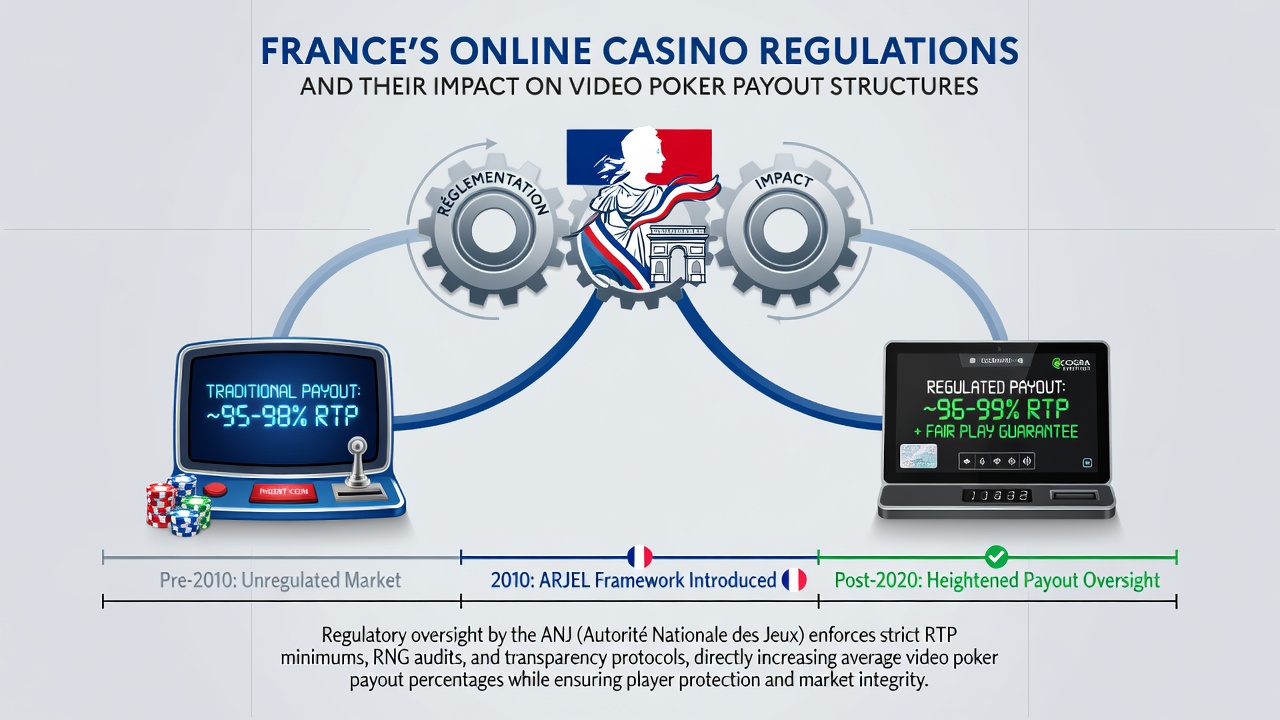
Because regulations cap maximum house edges and mandate periodic recalibration of paytables, video poker variants available to French players often feature tighter spreads between high and low denomination machines compared with unregulated markets, and this compression stems directly from requirements that all games maintain consistent statistical profiles across sessions. Researchers at European gaming institutes have documented how these constraints lead operators to adjust bonus round frequencies rather than base game returns in order to remain competitive while satisfying compliance checks.
One analysis of approved video poker titles revealed that progressive jackpot linkages receive additional scrutiny, with payout percentages for the main game held steady even as jackpot contributions accumulate, and this separation prevents dilution of standard hand payouts that players encounter during regular play. Figures released by industry monitoring groups indicate that French-regulated video poker maintains higher average returns than many peer jurisdictions, yet operators offset this through volume-based revenue models rather than aggressive edge increases.
Market Adjustments Following Regulatory Changes
Since the introduction of mandatory payout reporting in 2022 several major platforms have revised their video poker libraries to emphasize full-pay versions of Jacks or Better and Deuces Wild that align with the minimum return thresholds, while phasing out lower-paying variants that previously attracted less regulatory attention. Those who track license renewals observe that applicants must now provide detailed mathematical models showing how each game's payout structure interacts with player behavior data collected over six-month periods.
External verification through organizations such as the Autorité Nationale des Jeux ensures ongoing adherence, and cross-border comparisons with frameworks in Canada highlight how France's approach emphasizes real-time monitoring over periodic reviews alone.
Conclusion
France's regulatory structure continues to influence video poker payout mechanics by enforcing transparency, minimum return thresholds, and rigorous testing that together standardize offerings across licensed operators. As amendments take effect in August 2026 the emphasis on algorithmic verification will likely extend these controls further, shaping how providers balance player engagement with compliance demands in an evolving digital landscape. A separate study from the University of Sydney's gambling research unit provides additional context on similar regulatory patterns observed internationally, underscoring the interconnected nature of these oversight systems.